Une forte éruption garantit-elle des aurores ?
Non. Une éruption ne signifie pas une éjection dirigée vers la Terre. Le vent solaire, le champ magnétique, le lieu, l’obscurité et la météo comptent aussi.
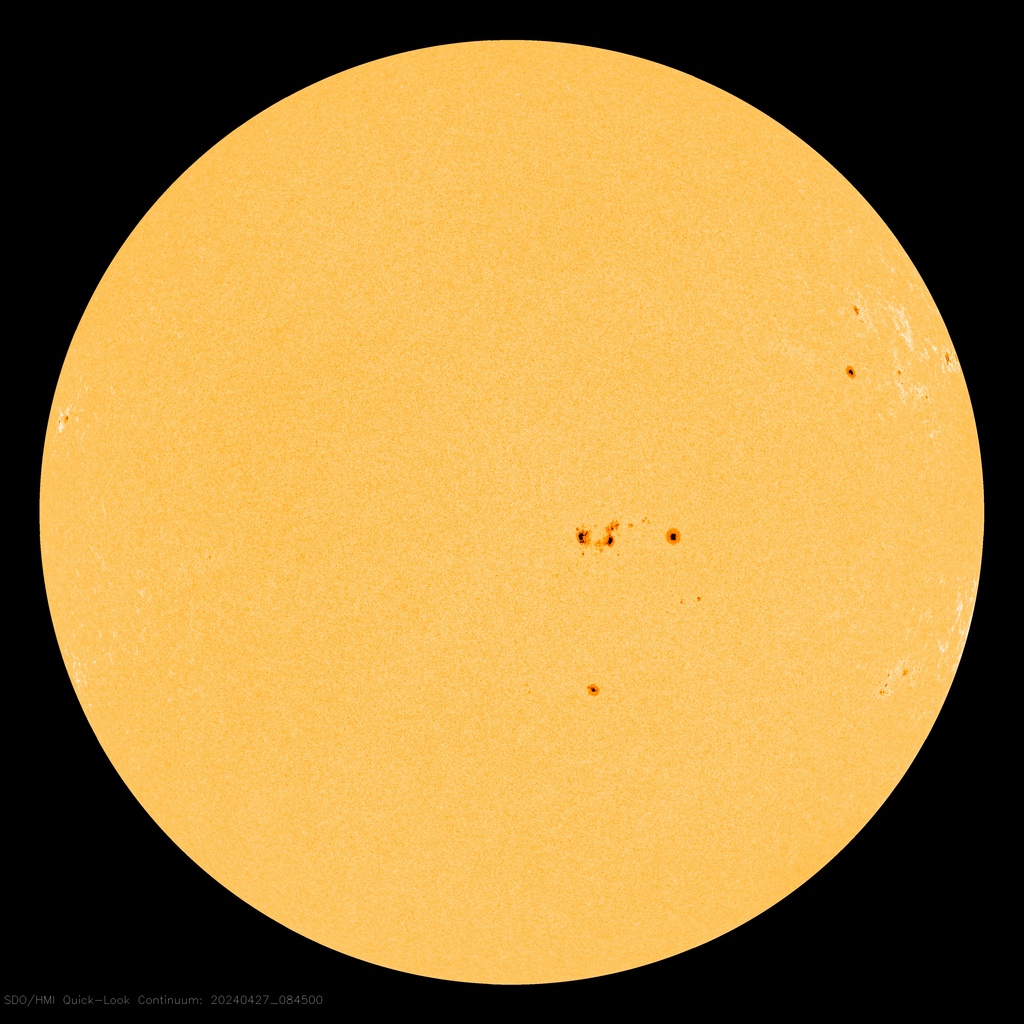
Le Soleil est-il actif aujourd’hui ? Suivez les éruptions solaires, les orages géomagnétiques et le vent solaire, puis consultez les prévisions d’aurores de votre région.
Les classes vont de A à X en passant par B, C et M. À chiffre égal, chaque classe est dix fois plus intense que la précédente.
Bt est l’intensité totale du champ. Un Bz durablement négatif indique une orientation vers le sud, favorable au transfert d’énergie, sans garantir une aurore.
Kp va de 0 à 9 ; les orages géomagnétiques commencent à Kp 5. Cet indice global n’est pas une probabilité d’aurore pour une ville.
:Product: 3-Day Forecast
:Issued: 2026 Oct 31 0030 UTC
# Prepared by the U.S. Dept. of Commerce, NOAA, Space Weather Prediction Center
#
A. NOAA Geomagnetic Activity Observation and Forecast

The greatest observed 3 hr Kp over the past 24 hours was 4 (below NOAA
Scale levels).
The greatest expected 3 hr Kp for Oct 31-Nov 02 2026 is 5.00 (NOAA Scale
G1).

NOAA Kp index breakdown Oct 31-Nov 02 2026

             Oct 31       Nov 01       Nov 02
00-03UT       5.00 (G1)    3.67         2.67
03-06UT       4.67 (G1)    4.67 (G1)    2.33
06-09UT       4.33         3.33         2.33
09-12UT       4.00         2.67         2.33
12-15UT       3.00         2.33         2.33
15-18UT       3.00         3.33         2.00
18-21UT       3.67         3.67         2.33
21-00UT       4.00         3.33         2.67

Rationale: The geomagnetic field is likely to reach G1 (Minor)
geomagnetic storm levels on 31 Oct - 01 Nov due to influence from a
positive polarity CH HSS. Unsettled conditions are likely on 02 Nov as
CH HSS influence wanes.

B. NOAA Solar Radiation Activity Observation and Forecast

Solar radiation, as observed by NOAA GOES-18 over the past 24 hours, was
below S-scale storm level thresholds.

Solar Radiation Storm Forecast for Oct 31-Nov 02 2026

              Oct 31  Nov 01  Nov 02
S1 or greater    1%      1%      1%

Rationale: No S1 (Minor) or greater solar radiation storms are expected.
No significant active region activity favorable for radiation storm
production is forecast.

C. NOAA Radio Blackout Activity and Forecast

No radio blackouts were observed over the past 24 hours.

Radio Blackout Forecast for Oct 31-Nov 02 2026

              Oct 31        Nov 01        Nov 02
R1-R2            1%            1%            1%
R3 or greater    1%            1%            1%

Rationale: No R1 (Minor) or greater radio blackouts are expected. No
significant active region flare activity is forecast.
:Product: Forecast Discussion
:Issued: 2026 Oct 31 0030 UTC
# Prepared by the U.S. Dept. of Commerce, NOAA, Space Weather Prediction Center
#
Solar Activity

.24 hr Summary...
Solar activity continued at very low levels. Newly numbered Region 4564
(N12E75, Hsx/alpha) rotated around the E limb with no apparent trailer
spot. It was mostly quiet and stable.

No Earth-directed CMEs were observed at the available coronagraph
imagery.

.Forecast...
Solar activity is expected to be at very low levels with a slight chance
for isolated C-class flares through 02 Nov.

Energetic Particle

.24 hr Summary...
The greater than 2 MeV electron flux reached high levels, with a peak
flux of 4,488 pfu observed at 30/1430 UTC. The greater than 10 MeV
proton flux remained steady at background levels.

.Forecast...
The greater than 2 MeV electron flux is expected to decrease to normal
to moderate levels on 31 Oct Oct and remain there through 02 Nov. The
greater than 10 MeV proton flux is anticipated to persist at background
levels through 02 Nov.

Solar Wind

.24 hr Summary...
Solar wind parameters suggested mild influence from a solar sector
boundary crossing. Total magnetic field strength reached a peak of 9 nT
and the Bz component reached as far south as -8 nT. Solar wind speeds
remained low, with values observed between 307-354 km/s. Phi angle
transitioned from mostly negative to positive after 30/0513 UTC.

.Forecast...
Solar wind disturbances are likely to be observed on 31 Oct and slow
wane through 02 Nov, due to the anticipated arrival of a recurrent,
equatorial, positive polarity CH HSS.

Geospace

.24 hr Summary...
The geomagnetic field was at quiet to active levels during the period.

.Forecast...
The geomagnetic field is expected to reach G1 (Minor) geomagnetic storm
levels on 31 Oct - 01 Nov due to influence from a positive polarity CH
HSS. Unsettled conditions are likely on 02 Nov as CH HSS influence
wanes.
:Product: 27-day Space Weather Outlook Table 27DO.txt
:Issued: 2026 Oct 26 0118 UTC
# Prepared by the US Dept. of Commerce, NOAA, Space Weather Prediction Center
# Product description and SWPC contact on the Web
# https://www.swpc.noaa.gov/content/subscription-services
#
#      27-day Space Weather Outlook Table
#                Issued 2026-10-26
#
#   UTC      Radio Flux   Planetary   Largest
#  Date       10.7 cm      A Index    Kp Index
2026 Oct 26      88           5          2
2026 Oct 27      84           5          2
2026 Oct 28      84           5          2
2026 Oct 29      84           5          2
2026 Oct 30      84           5          2
2026 Oct 31      84          30          5
2026 Nov 01      84          20          4
2026 Nov 02      82          10          3
2026 Nov 03      82           5          2
2026 Nov 04      82           5          2
2026 Nov 05      82          10          3
2026 Nov 06      82          10          3
2026 Nov 07      82          10          3
2026 Nov 08      84           5          2
2026 Nov 09      84          15          4
2026 Nov 10      82          10          3
2026 Nov 11      82          10          3
2026 Nov 12      80          10          3
2026 Nov 13      80           5          2
2026 Nov 14      80           5          2
2026 Nov 15      80           5          2
2026 Nov 16      80          10          3
2026 Nov 17      80          20          4
2026 Nov 18      80          20          4
2026 Nov 19      80          10          3
2026 Nov 20      80           5          2
2026 Nov 21      80           5          2
:Product: Summary of Space Weather Observations dayobs.txt
:Issued: 2026 Oct 31 0030 UTC
# Prepared by the US Dept. of Commerce, NOAA, Space Weather Prediction Center
# Product description and SWPC contact on the Web
# https://www.swpc.noaa.gov/content/subscription-services
#
#             Summary of Space Weather Observations
#
:Solar_Region_Summary: 2026 Oct 30
# Region   Location         Sunspot Characteristics
#           Helio                      Spot  Spot  Mag.
# Num   Lat.,CMD  Long.  Area  Extent  class count class
 4563    S19W94    353     10     1     AXX    1      A
 4564    N04E56    203     30     5     CRO    4      B
 4565    N12E75    184     60     2     HSX    1      A
L’activité du Soleil et les changements de l’environnement spatial proche de la Terre. Les éruptions, particules énergétiques et tempêtes géomagnétiques sont des phénomènes distincts.
Non. Une éruption ne signifie pas une éjection dirigée vers la Terre. Le vent solaire, le champ magnétique, le lieu, l’obscurité et la météo comptent aussi.
Les observations et prévisions publiques peuvent être retardées ou révisées. Elles ne garantissent ni la visibilité des aurores ni la sécurité opérationnelle. Suivez les consignes officielles pour les décisions importantes.